Hello gang,
Here is an interesting article from the MediaShift Idea Lab blog; expanded from an item in The Nieman Reports.
---------------------------------
Massive layoffs with no end in sight. Wave after wave of acquisitions and mergers fueled by the excesses of artificially cheap capital. Widespread fear that an entire industry and its contributions will stall or simply stop.
This describes the news industry today, but it also described the high tech industry in the late eighties and early nineties. Digital Equipment Corporation laid off people by the tens of thousands; Data General and Apollo Computer sank beneath the waves; Prime Computer fought off a hostile take-over attempt by corporate raiders only to die of its wounds; there was no Sam Zell to step in for Prime. IBM and Hewlett Packard survived, but never regained their roles as central innovators in their industry.
I am not a journalist. Today, I run a site that others often call an example of "citizen journalism," but I am a high-tech person from a family of high-tech people. My parents met over a minicomputer; my marriage comes with free lifetime technical support; our kids will know their emacs from their vi. I haven't gone anywhere, but your profession, journalism, has drifted steadily closer to mine. What's happening to you and yours now - layoffs, being out of work, thinking about taking up teaching, wondering if your kids should follow in your footsteps - happened to me and mine a few decades ago, and it made for a few miserable Thanksgiving dinners paid for with unemployment checks and spent with laid-off aunts, uncles, and cousins.
When our central institutions blew up, people asked many of the same questions I hear among journalists today. Without these institutions, who will fund the mission? How will we attract the talent we need to make the transition? Just as journalism without newspapers seems inconceivable now, it seemed inconceivable to many then that innovation could continue without the might, resources, and sheer heft of the companies that formed the core of the high tech industry. Who would write the next operating system? Create the next generation of microprocessors? Today, journalists ask how democracy will fare in a country without a robust free press. Then, technologists asked how the United States could retain its leadership position without big, powerful computing companies.
There's no underestimating the pain of the tech implosion: people who got laid off expected to be out of work for a year or more; people lost their houses, got divorced, left the industry entirely; lucky ones took early retirement packages. To make matters worse, many of them had deep loyalties to the companies they worked for and spoke with pride of the "HP way," the "IBM way." The breakdown also wasn't sudden: from beginning to end the dismantling took nearly a decade.
We decamped from the Titanic and dispersed in every direction in a fleet of kayaks: small, self-propelled, and iceberg-proof. We learned to be loyal to our friends and to the ideas and ideals that we had genuine passion for: because it was our friends who were going to pull us out of the cold water, and our ideas that would get us going again after a setback.
What we discovered, of course, was that innovation survived the death of its institutions. Only ten years after DEC founder and CEO Ken Olsen stepped down amid layoffs, Google had its IPO. If you are reading these words on the Web, both of us are the beneficiaries of LAMP, the "web stack" that serves the vast majority of websites to browsers across the world. An acronym for its components - Linux, Apache (a web server), MySQL (database), and PHP (scripting language) - each started as the contribution of an individual and is maintained by a distributed cast of thousands. The central innovations of the web today don't emerge from the labs of giants but from the dorm rooms of kids. And on them is built a big and varied industry with, yes, actual paychecks.
Do not mistake this message as a prediction that the news industry's current misery is mere stage-setting for a glorious resurgence. It isn't.
As the web, software, and news become a single industry, the stability and security we knew when our founding institutions were big and strong are gone and will never return. Gone with them are the sclerotic bureaucracy. Gone with them is the feeling of giving up changing anything because you can't even figure out how many people to ask for permission. All of these and more are as dead as IBM's dress code of blue blazer, red tie, white shirt.
Good riddance!
On the decks of a career Titanic, you don't have much choice but to sit back and let others ensure your safety and set your course. With a career in a kayak, you can and must set your own direction and learn the skills to keep yourself safe. You'll discover what thousands upon thousands of tech workers discovered: you can do great work outside of an institutional, big-company context, and you can make a living doing so. High tech companies didn't own innovation; the innovators did. News organizations don't own journalism: journalists do.

Jerry in Sri Lanka
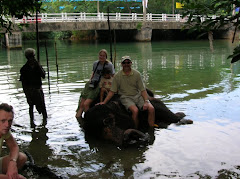
Helping bathe an elephant
About Me

- Jerry Renaud
- I am a broadcast journalism professor in the College of Journalism and Mass Communications at the University of Nebraska-Lincoln.
3 comments:
That was a very interesting comparison between two pretty different fields. I totally agree with him when he talks about being in your “kayak” and having to find the skills that you need to survive in the future. I wrote something similar to that in my paper.
I also found it interesting where he said that “As the web, software, and news become a single industry, the stability and security we knew when our founding institutions were big and strong are gone and will never return.” I guess that kinda goes back to the old idea that one person can make a difference.
I never really thought of technology and journalism as one entity, but as journalism begins to rely more and more on the internet I suppose they are becoming more and more one entity.
While traditional journalism jobs are declining, I still think there is plenty of opportunities for individuals to become involved in the industry. The jobs seem to just be shifting to other areas.
For example, I work at a communications unit that houses a video production/electronic media unit, news and information unit, graphic design and publishing sector, and a computing department. The video and electronic media unit are booming lately as many clients want videos and they want them to be put online. The publishing and distribution unit, on the other hand, are declining because many materials are going out over the Internet now.
There are still about the same number of journalism-related jobs, but they are in different areas than they once were. It seems every journalism job application I look at lately as asking for some level of Web experience.
I went to the American Copy Editors Conference recently and -- dang -- talk about change in the industry was everywhere, anywhere, all the time.
It didn't matter if you were in a session about skeptical editing, alternative story forms, math -- it was always the underlying issue.
It's enough to make even me a little nervous about the future of copy editing in particular, about journalism in general.
However, I was comforted at least a bit during my last session when the head of the desk at the Milwaukee Journal Sentinel said this talk of "Change is everywhere! What to do?" happened a couple decades ago, too. A J-school professor in the session talked about the sweeping changes occurring in all industries - not just journalism.
The industry may not look like it does now in, say, five or 10 years, but hopefully the experimentation with new technology that's going on will mean a better - not just different - journalism industry.
Post a Comment